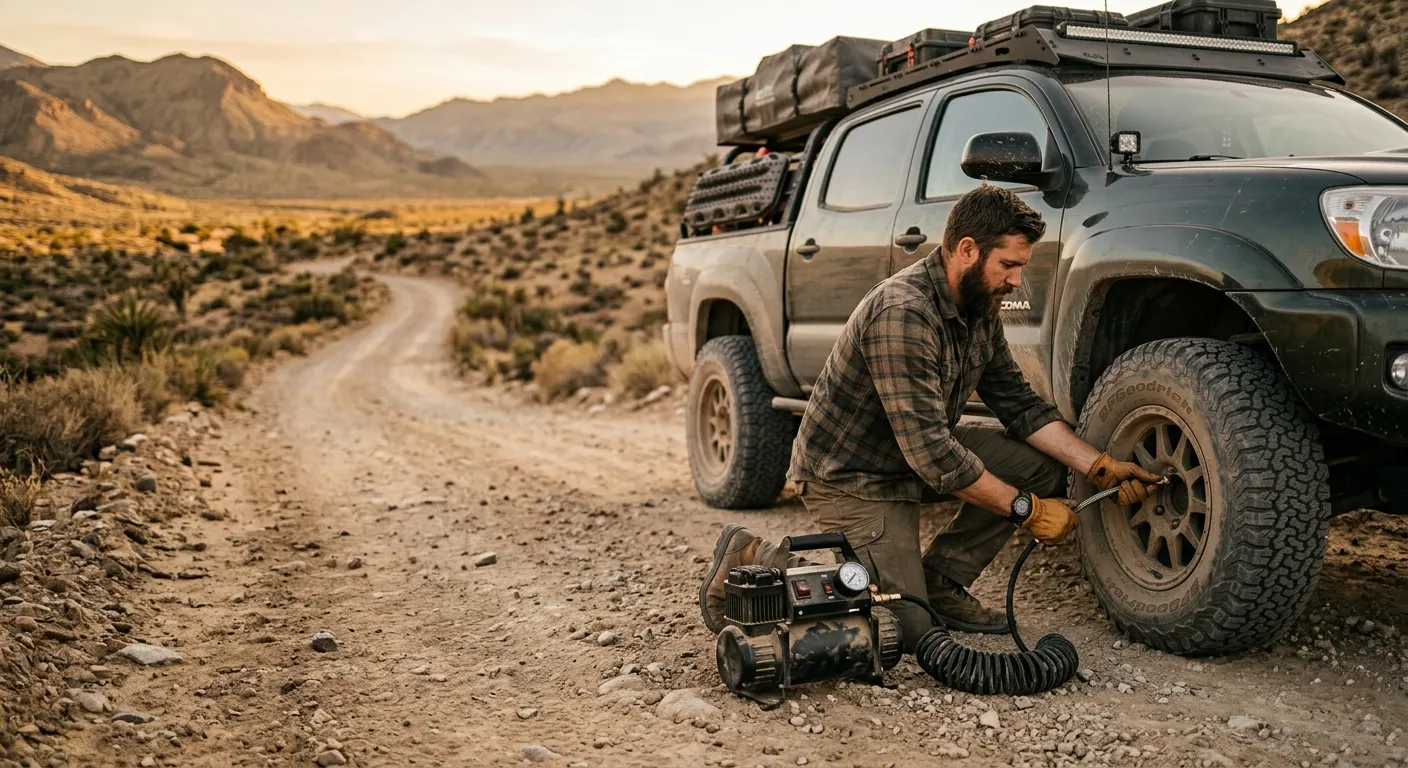
Dropping your tire pressure to 18 to 25 PSI on sand, loose dirt, or rocks changes the tire's contact patch dramatically, improving traction in ways that no amount of driver skill compensates for without it. The ARB E-Z Tire Deflator Valve gets you to target pressure on four tires in under five minutes. The ARB CKMTA12 Twin Motor Air Compressor gets you back to highway pressure before you hit the pavement again. The VIAIR 400P Portable Air Compressor does the same job in a more portable package at a lower price.
Quick answer
The ARB CKMTA12 twin compressor is the best choice for frequent overlanders with large tires who need fast, reliable fill times and will not overheat the unit. The VIAIR 400P is the best portable option for occasional use on tires up to 35 inches. Every overlander should carry an ARB E-Z Deflator regardless of which compressor they run.
This guide contains affiliate links. TrailBaseGear may earn a commission at no cost to you.
How much to air down and when
The general starting point is 18 to 22 PSI for sand and soft ground, 22 to 25 PSI for rocky terrain, and 25 to 28 PSI for forest roads. The exact numbers depend on your tire size, vehicle weight, and terrain. A wider, heavier vehicle generally needs lower pressures to achieve the same contact patch expansion as a lighter vehicle on the same tires.
The absolute limit is avoiding a bead break, where the tire separates from the rim under cornering force. Tubeless tires with beadlock wheels can go lower safely. Standard wheels should stay above 15 PSI under most conditions. When in doubt, start at 20 PSI and adjust based on whether the tire is visibly bulging at the sidewall.
Use the ARB E-Z Tire Deflator Valve to hit your target pressure consistently on each tire without stopping to check repeatedly. Set the calibrated valve to your target PSI, attach it to the Schrader valve, and it deflates to that pressure automatically.
Field reference / File TBG-013 air compressors tires

ARB E-Z Tire Deflator Valve
A calibrated Schrader valve tool that deflates four tires to a preset PSI automatically without guessing or checking repeatedly.
ARB CKMTA12: the permanent high-output option
The ARB CKMTA12 Twin Motor Air Compressor is a permanent under-hood installation that draws power from the battery and produces 6.16 CFM at 100 PSI. On a 35-inch tire at 15 PSI, filling to 35 PSI takes approximately 2 to 3 minutes per tire with a twin. Running all four tires at trail ride pace takes under 15 minutes from aired-down to highway-ready.
The 100-percent duty cycle is the critical spec: the ARB twin will not overheat and shut down during extended use, which matters when you are filling four large tires on a hot afternoon. Single-cylinder compressors with 33-percent duty cycles require 2-minute breaks for every minute of use.
Installation requires a professional or mechanically capable DIY. The compressor mounts in the engine bay with supplied brackets, the wiring connects to the battery with the included relay harness, and an air line runs through the firewall to an onboard outlet or direct to tire hoses.
Field reference / File TBG-051 air compressors tires

ARB CKMTA12 Twin Motor Air Compressor
A twin-cylinder 12V compressor with a 100-percent duty cycle, 6.16 CFM output, and a permanently mounted design built for repeated high-demand use.
VIAIR 400P: the portable option
The VIAIR 400P Portable Air Compressor clamps to the battery with included jumper-style leads and produces 1.47 CFM. On the same 35-inch tire scenario, fill times are roughly 5 to 7 minutes per tire, compared to 2 to 3 minutes for the ARB twin. Its 33-percent duty cycle requires rest intervals during multiple-tire fills.
For occasional overlanding, the VIAIR 400P is capable and the portable design is genuinely convenient: take it out when you need it, store it in the cargo area the rest of the time. It handles up to 35-inch tires effectively, which covers the majority of overlanding builds.
Field reference / File TBG-054 air compressors tires

VIAIR 400P Portable Air Compressor
A portable 12V compressor with a 150 PSI maximum working pressure and direct battery clamp connection, designed for tires up to 35 inches.
Field reference / File TBG-051 air compressors tires
ARB CKMTA12 Twin Motor Air Compressor
A twin-cylinder 12V compressor with a 100-percent duty cycle, 6.16 CFM output, and a permanently mounted design built for repeated high-demand use.
Field reference / File TBG-054 air compressors tires
VIAIR 400P Portable Air Compressor
A portable 12V compressor with a 150 PSI maximum working pressure and direct battery clamp connection, designed for tires up to 35 inches.
Field reference / File TBG-013 air compressors tires
ARB E-Z Tire Deflator Valve
A calibrated Schrader valve tool that deflates four tires to a preset PSI automatically without guessing or checking repeatedly.
Field reference / File TBG-010 recovery gear
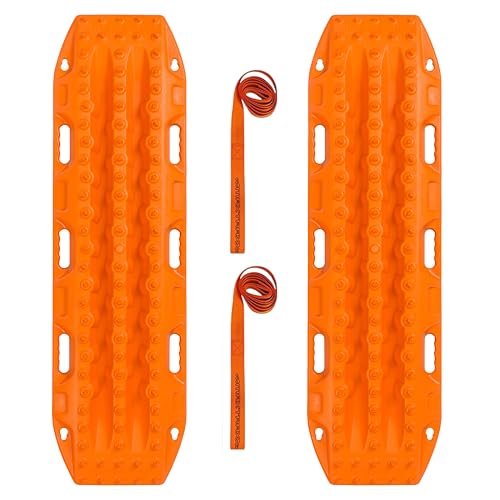
MAXTRAX MKII Vehicle Recovery Boards
The gold-standard traction boards used by professional expedition teams, molded in reinforced nylon with aggressive cleats that bite into sand, mud, and snow.
FAQ
Frequently asked questions
What PSI should I air down to for overlanding?+
Start at 18 to 22 PSI for sand and soft ground, 22 to 25 PSI for rocks and technical terrain, and 25 to 28 PSI for maintained dirt roads. The exact number varies by tire size and vehicle weight. Wider tires on heavier vehicles often need to go lower to achieve the same footprint benefit. Never go below 15 PSI on standard tubeless tires without beadlock wheels.
How long does it take to air up four tires?+
With an ARB CKMTA12 twin compressor filling from 15 PSI to 35 PSI on 35-inch tires, expect 2 to 3 minutes per tire or 10 to 15 minutes total. A VIAIR 400P single-cylinder takes 5 to 7 minutes per tire, but the duty cycle requires a 2-minute rest between tires. Budget 25 to 35 minutes for four tires with a portable single-cylinder unit.
Can I use a gas station air pump instead of carrying a compressor?+
In principle yes, if you are close to a gas station when you return to pavement. In practice, overlanding routes often exit pavement miles from a gas station, and the extra miles on an aired-down vehicle at highway speeds carries real risk of a bead break or handling problems. Carrying your own compressor eliminates that dependency and lets you air back up immediately at the trailhead.